While the art world often thrives on noise, spectacle, and self‑promotion, one figure has spent decades proving the opposite: a phantom whose silence spoke louder than any spotlight. Banksy.
His famous line “Invisibility is a superpower” takes on a new resonance today. True relevance does not arise from constant visibility, but from the ability to focus on what matters – the message, not the face behind it.
Who is Banksy? A trail that grows sharper
For years, speculation circled around the identity of the world’s most influential street‑art artist. Now, after extensive research, the news agency Reuters reports that much points to Robin Gunningham – a name long whispered in the background. At times, Banksy is said to have used the alias David Jones to further protect his anonymity.
Whether definitively proven or not, the clues have never been this concrete.
Why the Banksy brand worked
Banksy understood something many artists overlook: Anonymity is not a limitation – it is a concept.
He placed his works not in galleries, but in the public sphere. Not where art is expected, but where it disrupts, irritates, provokes.
His collectors were not the traditional art‑market elite. They invested not only in an artwork, but in a narrative: the mystery, the rebellion, the refusal to be owned.
His market value soared – not despite his invisibility, but because of it. The artwork was not the price. The myth was the price.
What happens when a phantom gains a name?
Now the crucial question arises: What becomes of a brand built on invisibility when a name suddenly enters the room?
Art economist Magnus Resch puts it succinctly: “Banksy revolutionized the art world. Everyone knows his works, but no one knew his face – until now. And that makes the future of his market value fascinating.”
Two paths lie ahead:
- He continues underground, working as before – then the market value may decline as the myth erodes.
- He enters the institutional art world – galleries, museums, major venues – and could stabilize his multimillion‑dollar status.
England has always loved its phantoms. After Jack the Ripper, the country now has another – only this one spread art instead of fear.
A book that opens Banksy’s world without demystifying it
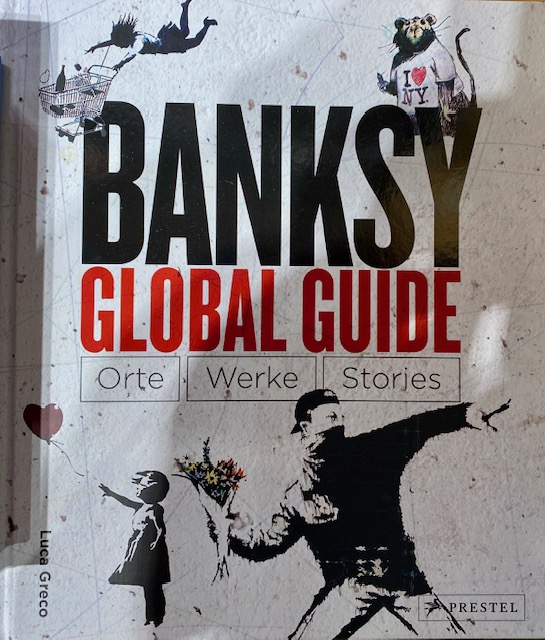
Among the publications about Banksy, one particularly compelling volume from Prestel stands out. It guides readers to more than 170 locations worldwide where Banksy’s works have appeared – or disappeared. The book highlights not only the iconic pieces but also the empty spaces: destroyed, removed, or vanished works. A quiet reminder of the fragility and transience of street art.
What I take from this as an artist
Banksy reminds me that art is not defined by institutions, but by integrity. It is not about the words of curators, galleries, or museums. It is about how independently I work, what voice I raise, what mirror I hold up to the world.
Art is not decoration. Art is commentary. Banksy mastered this language with precision and courage.
 linossiartstory